Guides · Fittings
Vessel heads and the chart: what the app does with them
Six tiles under Vessel Ends, the Common Vessel Head Types chart as a dropdown, and the gore that comes out with CUT n OFF on it.
The six tiles
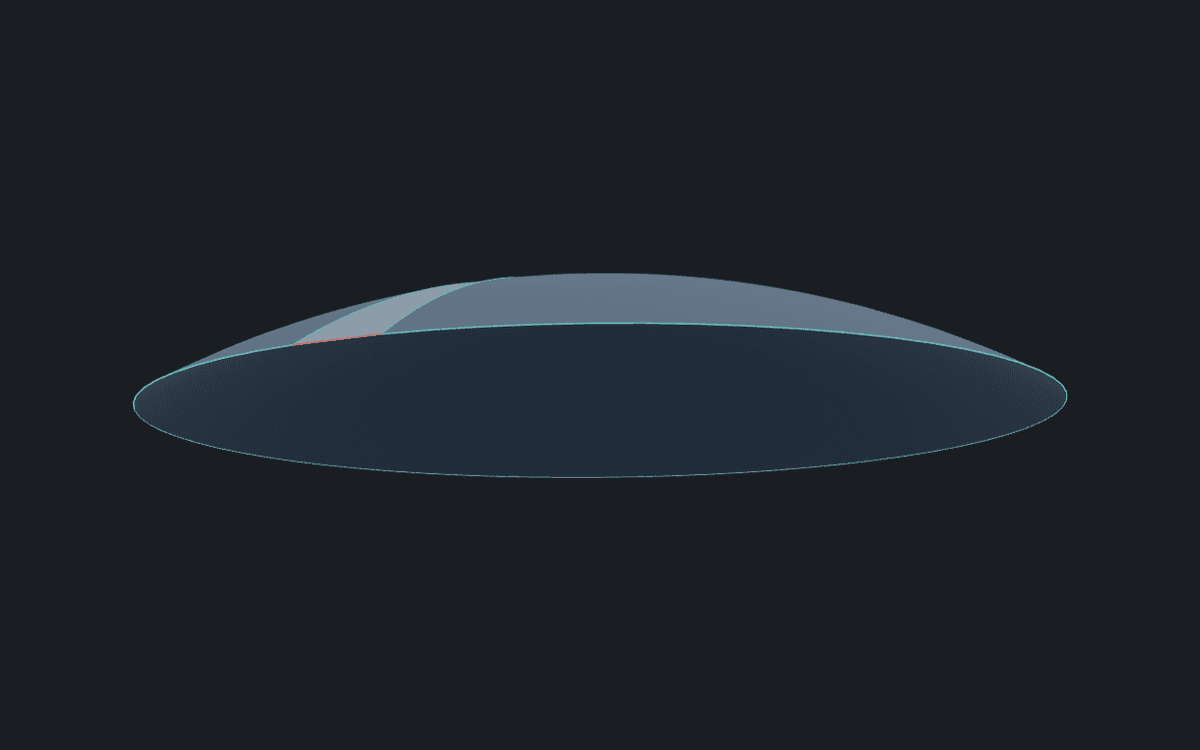
Dome, Dished End and Hemispherical Dome take a diameter and a height, the site-workshop way. The three head tiles - 2:1 Ellipsoidal Head, Torispherical Head and Spherical Cap - take the vessel head the way a plate shop names it, and they are where the chart lives.
You give it
| Input | How |
|---|---|
| Vessel head Ø | The vessel itself, not the cladding. The cladding is the profile pushed out by the insulation along its normal: the same arc centres, every radius grown by the insulation thickness, which is what the chart says to do |
| Head type | A dropdown of the chart: Klöpper (DIN), Korbbogen (DIN), 2:1 bi-radial, French 1.9:1, ASME 100/6, 80/10 and 80/6, dished only, hemispherical - or type the radii off the drawing |
| Insulation | mm, as on every fitting; a head with no knuckle meets the body band above the vessel corner and the pattern says how far |
| Gores | Any count; the pattern is one gore and says CUT n OFF |
| Swage, each edge | The swager’s wheel setting from the cut edge, drawn as its own line. Two beads nest when the two settings total the two strips, and the pattern prints CHECK when they do not |
| Rivets | Up the seams, as a count; the hole line is the same shift on both edges, so this gore’s right-hand holes are the next gore’s left-hand holes |
| Body lap | At the rim, where the head meets the body band |
It gives you
- One gore, developed on its true meridian with a station every 15 mm, so a CNC curve comes out smooth.
- The swage line and the seam line on both edges, with where the next gore’s cut edge lands marked, the rivet holes, and the blank disc diameter printed on the pattern.
- The Klöpper, Korbbogen and 2:1 figures come out of the engine to the chart’s own rounding, held there by the app’s own test suite.
- 1:1 on A4 or A3 with the bar; a tall gore tiles across several sheets. DXF for the plasma.
It refuses
- A hole line outside the overlap. It prints a CHECK line instead of a bad pattern.
- Two beads that do not nest. CHECK again.
Still unproven in the shop: the forming allowance on a rolled gore. Offer the first gore up before you cut the set.